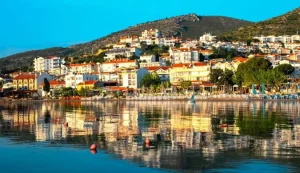
How to Get to Datca?


Datca sits at the end of a stunning peninsula in Mugla, where the Aegean and Mediterranean vibes blend into one long ribbon of coves, villages, and fresh sea air. Because there is no airport in Datca itself, most travelers arrive by flying to Dalaman (DLM) or Milas Bodrum (BJV) and then continue by bus, transfer, or rental car. If you are comparing routes, starting with a Datca Flight Ticket search for Dalaman or Bodrum is usually the fastest way to get close, and then you can pick the most convenient onward connection.
Travel to Datca by Air
From Turkey
For domestic travel, your goal is to land at Dalaman Airport (DLM) or Milas Bodrum Airport (BJV), then finish the trip overland or by ferry. From Istanbul (IST or SAW), Ankara (ESB), Izmir (ADB), Bursa, Antalya, Adana, or Gaziantep, you can typically find frequent flights to both airports depending on season and airline. After landing, the simplest plan is either a direct coach when available, or a transfer via Marmaris or Mugla Otogar, then onward to Datca. Rome2rio lists the typical airport to Datca journey as roughly 3 to 4 hours by bus with transfers, while driving can be around 2.5 hours from Dalaman depending on route and traffic.
A practical bonus: Dalaman Airport notes that MUTTAS runs coach services seasonally between Dalaman Airport and Datca, which can save you a connection in peak months.
From Europe
From Europe, you have two easy patterns. The first is flying to Istanbul and connecting onward to Dalaman or Bodrum, which works year round. The second is using seasonal direct flights to the region, especially from major hubs and holiday gateways like London, Manchester, Birmingham, Amsterdam, Paris, Berlin, Munich, Frankfurt, Vienna, Zurich, Brussels, Copenhagen, Stockholm, Oslo, and Dublin, then continuing to Datca by road. Dalaman Airport publishes a long airline list, and Milas Bodrum Airport publishes a route map showing broad international connectivity, which is why both airports are popular entry points for Datca in summer.
From Asia
If you are coming from the Middle East or broader Asia, connections through Istanbul are the smoothest. From cities like Dubai, Abu Dhabi, Doha, Kuwait City, Riyadh, Jeddah, Tel Aviv, Amman, Beirut, Tbilisi, Baku, and Tehran, you can usually route into Istanbul and then hop to Dalaman or Bodrum. For travelers from Central and South Asia, common starting points include Delhi, Mumbai, Karachi, Lahore, Islamabad, and Colombo via one stop in Istanbul, then the final leg to the coast.
From North America
From New York, Boston, Washington DC, Chicago, Toronto, Montreal, Vancouver, Los Angeles, and San Francisco, the most reliable option is a long haul flight to Istanbul, then a domestic connection to Dalaman or Bodrum. To reduce total travel time, many travelers choose an overnight arrival into Istanbul and continue the same day, then book a private transfer for the last stretch to Datca, especially if arriving with family or lots of luggage.
From South America
From Sao Paulo, Rio de Janeiro, Buenos Aires, Santiago, Bogota, and Lima, you will almost always connect via a major European hub (Madrid, Paris, Amsterdam, Frankfurt, London) or via Istanbul, then continue to Dalaman or Bodrum. If you want to keep the itinerary simple, aim for one connection into Istanbul and one domestic hop to the coast.
From Africa
From North Africa (Casablanca, Marrakech, Algiers, Tunis, Tripoli, Cairo) and from larger Sub Saharan hubs (Addis Ababa, Nairobi, Lagos, Accra, Johannesburg, Cape Town), the most straightforward route is usually into Istanbul, then onward to Dalaman or Bodrum. Once you land, you can time your arrival with a bus connection to Marmaris or Mugla and then continue to Datca.
From Oceania
From Sydney, Melbourne, Brisbane, Perth, Auckland, and Wellington, the standard route is via a Middle East hub (Dubai, Doha, Abu Dhabi) or via Southeast Asia and Europe, then onward to Istanbul, and finally to Dalaman or Bodrum. Given the long journey, many travelers plan one night in Istanbul, then travel to Datca the next morning to arrive rested.
Travel to Datca by Road
From Turkey
Road travel to Datca is part of the adventure, with mountain views, pine forests, and long sea panoramas as you approach the peninsula. If you are driving, Marmaris is a common midpoint, and Rome2rio lists the Marmaris to Datca drive at about an hour for roughly 71 km, depending on the exact route and traffic.
Intercity buses are also popular. From Istanbul, buses can take around 13.5 hours according to FlixBus, and services like Kamil Koc are commonly listed on the route. From Ankara, you can expect roughly an 11 hour plus trip depending on operator and schedule. From Izmir, you can either drive (about 323 km and just under 4 hours in typical conditions) or take a bus via Mugla.
Once you arrive at Datca bus station, local minibuses (dolmus) and taxis make it easy to reach the center, Eski Datca, or bays like Palamutbuku and Hayitbuku.
From Europe
If you want a full road trip, you can drive from Europe through Greece or Bulgaria into Turkey, then continue toward Mugla and the Datca Peninsula. Common starting points include Athens, Thessaloniki, Sofia, Bucharest, Belgrade, Skopje, Sarajevo, Zagreb, Budapest, Vienna, Prague, Munich, and Milan. Many drivers break the journey with an overnight stop around Istanbul, Izmir, or Aydin, then continue to Marmaris and Datca.
From Asia
Overland routes from nearby regions often start from Georgia (Tbilisi, Batumi), Azerbaijan (Baku), or Iran (Tabriz, Tehran), entering Turkey and continuing toward western Anatolia. From cities like Ankara, Konya, Kayseri, and Bursa, the trip is manageable with a daytime drive plus rest stops, or an overnight bus and a morning arrival.
From North America
A true road arrival from North America is rare, but some travelers combine a European rental itinerary with Turkey, especially if they are already touring the Balkans or Greece. In that case, plan border crossing time, confirm insurance coverage, and avoid tight schedules so you can enjoy coastal stops near Bodrum, Akyaka, Marmaris, and Hisaronu Bay.
From South America
Most South American visitors arrive by air first, then switch to road travel for the final portion. If you are planning a multi city Turkiye route, popular overland segments include Istanbul to Izmir, Izmir to Bodrum, Bodrum to Marmaris, and finally Marmaris to Datca.
From Africa
From North Africa, some travelers do mixed itineraries via Greece and western Turkey, then continue by car. More commonly, visitors fly into Istanbul and then rent a car for a scenic drive down the coast.
From Oceania
Visitors from Australia and New Zealand typically fly into Turkey, then use road travel for the last leg. If you want flexibility, renting a car from Dalaman is a strong option, especially if you want to explore Selimiye, Bozburun, Orhaniye, or the small villages across the Datca Peninsula before settling in town.
Travel to Datca by Sea
From Turkey
The signature sea route is the Bodrum to Datca ferry. The BodrumFeribot timetable page describes departures from Bodrum Kale Port and arrivals on the Datca side at Kairos Marina. Travel writers commonly note the crossing is about 105 minutes in typical conditions, and that onward transport into Datca town can be arranged after arrival.
This option is especially handy if you are already in Bodrum, Turgutreis, or nearby coastal resorts and want to skip some of the longer road loop around the gulf. It can also pair nicely with a flight into Bodrum Airport, then a quick transfer to the port, then a ferry into Datca.
From Europe
Coming from Europe by sea usually means you first reach a Turkish coastal hub, then continue by ferry. If you are island hopping in the Dodecanese (like Kos, Rhodes, or Symi), a common pattern is ferry to Bodrum, then ferry onward to Datca if schedules line up. Because international routes can change by season and port permissions, confirm current departures close to your travel date.
From Asia
Sea arrivals from Asia are usually part of a longer Mediterranean cruise plan, or a mixed itinerary that starts with flights into Istanbul or Izmir and then heads to the coast. If you are in coastal cities like Izmir, Kusadasi, or Antalya, you can combine buses and short sea crossings (for example via Bodrum) to reach Datca in a more scenic way.
From North America
For North American travelers, sea travel is typically an add on after flying in. A popular route is landing in Istanbul, visiting the Aegean coast, spending a couple of nights in Bodrum, then taking the Bodrum Datca ferry for a relaxed entrance that feels like arriving on a postcard.
From South America
Many South American visitors love a coastal hopping plan: Istanbul, Cappadocia, then down to the Aegean. Once you reach Bodrum or Marmaris, adding a ferry segment gives your trip variety and saves energy compared with long overland backtracking.
From Africa
If you are coming from North Africa via the eastern Mediterranean, you will usually connect through major Turkish ports and coastal hubs rather than arriving directly into Datca. The most practical approach is still to reach Bodrum or Marmaris first, then use the local ferry or road network.
From Oceania
From Oceania, sea travel is a treat after the long flight. If you are building a slow travel itinerary, consider ending in Datca after Bodrum, because the ferry crossing is short, scenic, and drops you close to quiet bays, local markets, and the peninsula vibe that makes Datca feel different from bigger resorts.
Datca rewards the extra effort it takes to reach the peninsula. Whether you arrive by a quick flight to Dalaman, a classic overnight bus from Istanbul, or a sea crossing from Bodrum that opens up to blue water and rugged hills, the journey becomes part of the story you will tell later. Plan it today with Datca Flight Ticket, Datca Buy Ticket and Datca Ferry Ticket.