How to Get to Fethiye?

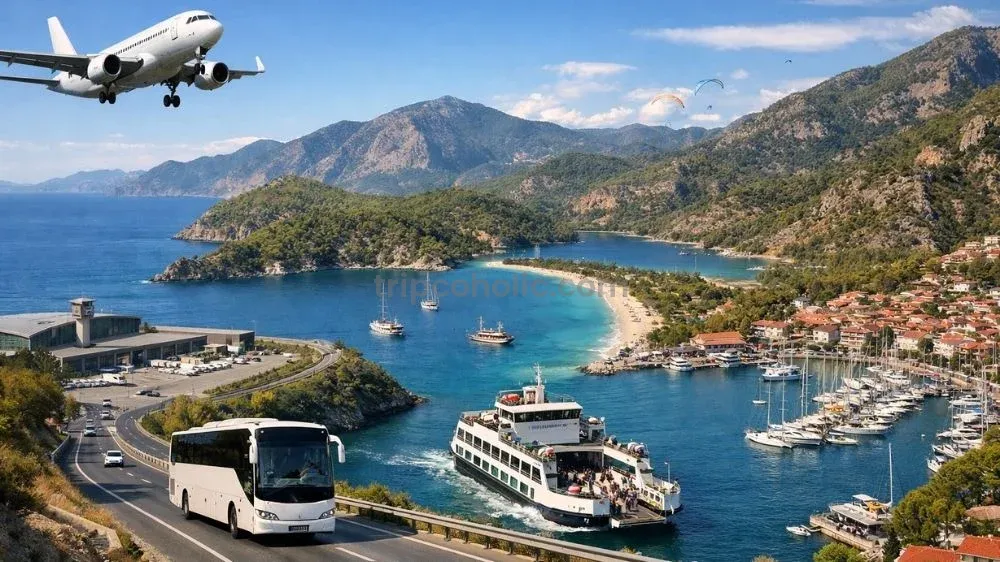

Set on Turkey’s Turquoise Coast, Fethiye is easy to reach by plane via nearby airports, by long distance bus or car from almost anywhere in Turkey, and even by sea on seasonal international ferries. If you are comparing Fethiye Flight Ticket options, the smartest move is usually flying into Dalaman and finishing the trip with a short road transfer to town. Dalaman Airport is roughly 45 km from central Fethiye, so you can go from landing to seaside views in under an hour.
Air Travel
From Turkey
Fethiye does not have its own airport, so you will be choosing between nearby gateways:
- Dalaman Airport (DLM): The closest and most convenient option for Fethiye, Ölüdeniz, Hisarönü, Ovacık, Çalış Beach, and Göcek. The road distance to Fethiye is around 45 km.
- Antalya Airport (AYT): A solid backup if prices are better or if you also plan to explore Antalya, Kaş, Kalkan, or the Lycian coast by car.
Typical domestic routing is simple: Istanbul, Ankara, and Izmir have frequent flights to Dalaman in many seasons, and during peak periods you may also find options via other large cities. After you land, you can continue by airport shuttle, intercity bus connections, taxi, or private transfer.
Practical tip: If your accommodation is in Oludeniz, Faralya, Kabak, Kayakoy, or Gocek, confirm your final drop off point in advance. Fethiye is a region with multiple popular hubs, and the “closest” ride depends on where you are staying.
From Europe
In the warmer months, Dalaman often becomes one of the Mediterranean’s busiest holiday airports, with direct or one stop connections from many European hubs. Depending on the season, travelers commonly route from London, Manchester, Birmingham, Dublin, Edinburgh, Berlin, Munich, Frankfurt, Düsseldorf, Cologne, Hamburg, Vienna, Zurich, Geneva, Amsterdam, Rotterdam, Brussels, Paris, Marseille, Milan, Rome, Copenhagen, Stockholm, Oslo, Helsinki, Madrid, and Barcelona.
If you cannot find a convenient direct flight, the easiest one stop paths are usually:
- Via Istanbul and then onward to Dalaman
- Via major European hubs such as London, Frankfurt, Munich, Vienna, Zurich, Amsterdam, or Paris, then onward to Turkey
From Asia
For the Middle East and wider Asia, the most comfortable routings tend to connect through major hubs:
- Dubai, Abu Dhabi, Doha, Kuwait City, Riyadh, Jeddah, Muscat, Bahrain
- Baku, Tbilisi, Almaty, Tashkent (often via Istanbul or a Gulf hub)
- Delhi, Mumbai, Karachi, Lahore (commonly via Gulf hubs or Istanbul)
- Singapore, Kuala Lumpur, Bangkok, Hong Kong, Tokyo, Seoul (typically via Istanbul or Gulf hubs)
If your itinerary is multi stop, consider pairing Fethiye with Cappadocia, Pamukkale, or Istanbul by planning an open jaw route: arrive in one Turkish city and depart from another.
From North America
From New York, Boston, Washington DC, Miami, Chicago, Dallas, Los Angeles, San Francisco, Toronto, Vancouver, and Montreal, the smoothest options are usually one stop via Istanbul or two stops via a large European hub. Once in Turkey, connect to Dalaman and transfer by road.
From South America
From São Paulo, Rio de Janeiro, Buenos Aires, Santiago, Lima, Bogotá, most itineraries route through Europe or the Middle East before reaching Istanbul and then Dalaman. If you are carrying sports gear like paragliding equipment or diving kits, check airline baggage policies early.
From Africa
From Cairo, Alexandria, Casablanca, Marrakesh, Tunis, Algiers, Nairobi, Addis Ababa, Johannesburg, Cape Town, routes commonly connect via Istanbul or Gulf hubs. For North Africa, Europe can also be a practical stepping stone.
From Oceania
From Sydney, Melbourne, Brisbane, Perth, Auckland, the usual pattern is a long haul to Dubai, Doha, Singapore, or Istanbul, then onward to Dalaman. If you are visiting in summer, booking early can make a big difference because Dalaman’s holiday demand rises fast.
Road Travel
From Turkey
Road travel is one of the classic ways to reach Fethiye, especially if you want flexibility for beaches, bays, and mountain viewpoints.
By intercity bus: Fethiye has a central bus station (otogar) with services connecting to major cities across Turkey. You can commonly find routes from:
- Istanbul, Ankara, Izmir, Bursa
- Antalya, Mugla, Marmaris, Bodrum
- Denizli (Pamukkale), Aydin, Manisa, Konya
- Adana, Mersin, Eskisehir (often with connections)
From Izmir, the road distance is around 337 km, which gives you a sense of the regional scale when planning stops along the Aegean coast.
From Istanbul, overnight buses are popular because you arrive in the morning ready for the sea and sunshine, though total journey time varies by route and traffic.
By car: If you are driving, the scenery is part of the reward. Common approaches include:
- From Izmir and the northern Aegean: follow routes toward Aydın and Muğla, then continue to Fethiye
- From Antalya: take the coastal direction past Kemer and Kumluca, then toward Kaş, Kalkan, and into Fethiye province
- From Denizli and Pamukkale: a straightforward inland approach that is great for combining thermal pools with the coast
If you plan to explore Oludeniz, Babadag, Saklikent Gorge, Kayakoy, Patara, or the bays around Gocek, having a car can be a huge advantage. For summer driving, plan around peak check in times and beach traffic.
By rail plus bus: Fethiye does not have a train station, but you can use rail for part of the journey by heading to a nearby rail city such as Denizli, then switching to a bus for the final leg.
From Europe
Driving from Europe is absolutely doable if you enjoy long road trips. Common overland routes pass through:
- Bulgaria (often entering Turkey via the Edirne region)
- Greece (and then into western Turkey)
Popular starting points include Athens, Thessaloniki, Sofia, Bucharest, Belgrade, Skopje, Sarajevo, Zagreb, Budapest, Vienna, Munich, Milan, with the final Turkish segment typically running through Istanbul or the Aegean corridor depending on your chosen route.
If you prefer not to drive the whole way, a comfortable alternative is to fly to Istanbul or Izmir, then continue by bus or domestic flight to Dalaman.
From Asia
From nearby regions, overland entry can make sense for flexible itineraries:
- From the Caucasus: routes via Georgia into Turkey, then across to the Aegean
- From the Middle East: travel via large Turkish cities, then head southwest toward Mugla province
Long distances mean you should plan rest stops, especially if you intend to continue past Fethiye to Marmaris, Datca, Bodrum, or Antalya.
From North America, South America, Africa, and Oceania
For most travelers from these continents, road travel mainly applies after landing in Turkey. A common pattern is:
- Fly into Istanbul, Izmir, Ankara, or Antalya
- Continue to Fethiye by bus or rental car
- Use Fethiye as a base for day trips along the Lycian coast
Sea Travel
From Turkey
Fethiye is a proper maritime town with a lively marina culture. Within the region, sea travel is often about experiences rather than point to point commuting:
- Day cruises and bay hopping from Fethiye harbor
- Blue cruise style gulet trips that link Fethiye with Göcek bays and other coastal highlights
- Private яхт or sailing itineraries that combine swimming coves, island stops, and sunset anchorage
If you are arriving by sea from elsewhere in Turkey, you may find it easier to use a larger ferry network point first (such as routes involving major Aegean ports) and then continue by road to Fethiye.
From Europe
Fethiye has a well known international ferry link to the Greek island of Rhodes, and this is one of the most enjoyable ways to arrive if you want your trip to begin with sea views. Ferries on the Fethiye to Rhodes route operate year round with more frequent sailings in summer, and the crossing is typically around 1.5 to 2 hours.
Rhodes is easy to reach from many European cities, so a popular two step plan is:
- Fly to Rhodes from cities like London, Berlin, Amsterdam, Vienna, Rome, Paris, Stockholm, Athens
- Take the ferry to Fethiye, then continue onward to your hotel
Bring your passport, allow time for border procedures, and double check seasonal schedules because Mediterranean routes can change with demand and weather.
From Asia, North America, South America, Africa, and Oceania
For most travelers from these regions, sea travel becomes relevant as an add on rather than the primary route:
- Arrive in Turkey by air, then include a Rhodes side trip by ferry
- Combine Fethiye with other Mediterranean ports via regional cruising that uses Rhodes or other nearby harbors as stepping stones
- Use the sea for what it does best in this area: islands, bays, and unforgettable coastlines
Fethiye is the kind of place where the journey can be as memorable as the destination: a quick hop to Dalaman and a short transfer, an overnight bus that delivers you straight into a sunny morning, or a ferry ride that turns arrival into a mini vacation. Choose the route that fits your schedule and travel style, then let Fethiye reward you with turquoise water, mountain panoramas, and a coastline built for slow, beautiful days. Whether you book Fethiye Flight Ticket, Fethiye Bus Ticket, or Fethiye Ferry Ticket, you can shape your trip to match your budget, timing, and sense of adventure.